Snapshot: Papala kepau

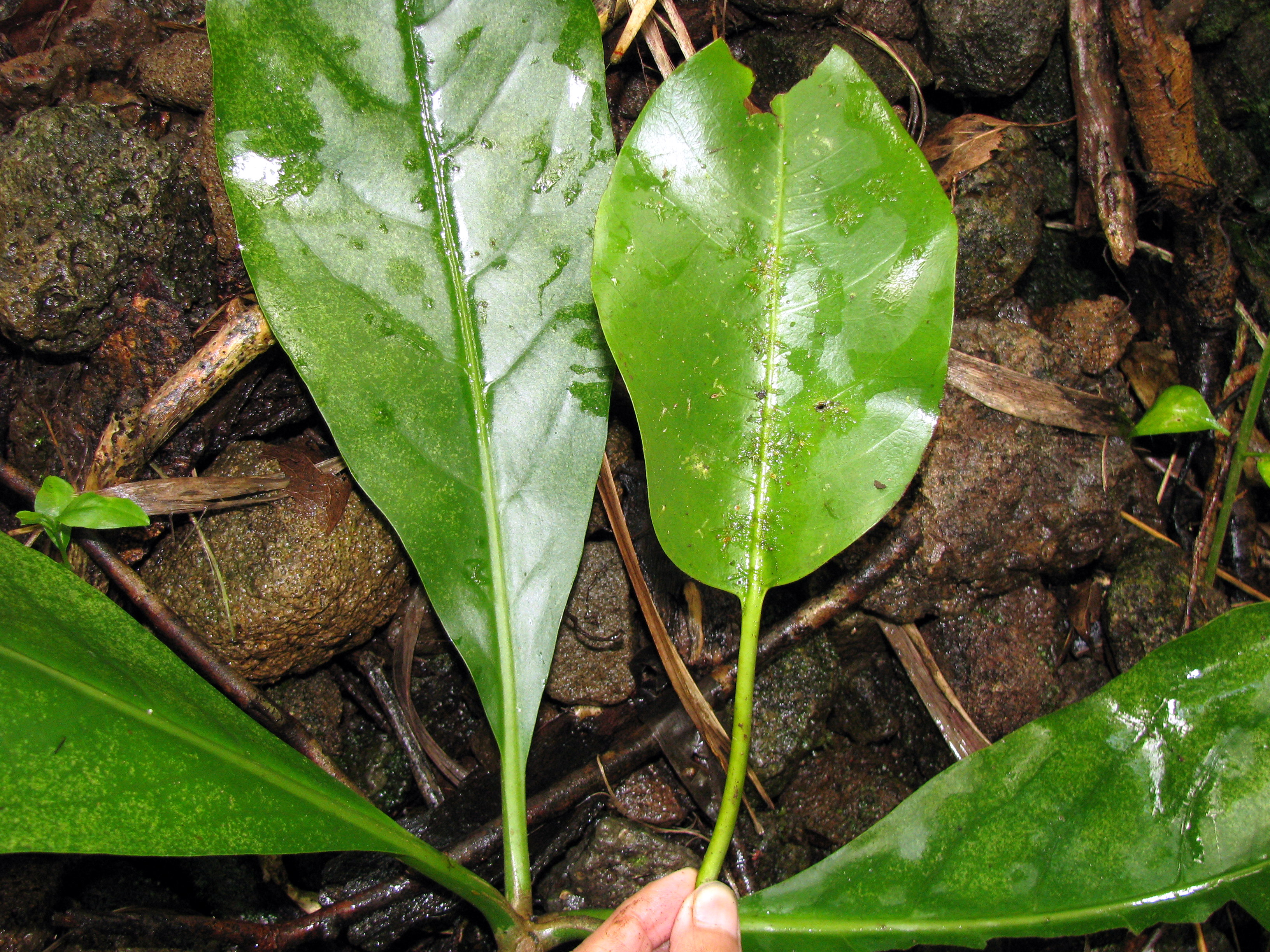
Time for another comparison. The larger leaf on the left is the common species of Papala kepau (Pisona umbellifera) in the Ko’olaus. The one on the right is the rarer Pisona sandwicensis. As you can see, the leaf bases are much different. P. sandwicensis has a much more truncate leaf base and a better defined petiole, whereas P. umbellifera has a cuneate base and less of a petiole. Naturally, there are other differences as well. But I hope this helps in the field.

Posted in Botany | Tagged , | Leave a comment

Getting to know your Hawaiian Lobeliads #17: Cyanea pohaku

Cyanea pohaku

  • Conservation Status: Extinct
  • Distribution: East Maui (Pu’unianiau)
  • Date photographed: October 11, 1910? (J.F. Rock)
  • *Identification: Form– Sparingly branched trees 6-7 m tall. Leaves– oblanceolate; blades 16-30 cm long by 1.5-4 cm wide; margins callose-crenulate; winged petioles 0.8-2 cm long. Flower– hypanthium obconical, 12-17 mm long; calyx lobes narrowly triangular, 4-7 mm long, 1-2 mm wide; corolla greenish-white, 30-45 mm long, 5-7 mm wide
  • Phylogenetic comments: Originally described by Rock as Clermontia haleakalensis,  it was later moved (Lammers, 1988) to Cyanea bearing the new name Cyanea pohaku.
  • My notes: How lucky are we that the great Joseph Rock was also an excellent photographer? One of the absolute strangest of the Hawaiian Lobeliads could have been lost forever in time without a trace; Rock was the only scientist to ever describe this species before its entire habitat was lost. Take a close look at the picture, C. pohaku has a fairly stout trunk, in the lower left of the photo is a hat to give some scale. It looks to be a 1-2 ft. girth at the base. Weird. C. pohaku was also known from one of the highest elevation ranges for Hawaiian Lobeliads at around 7,000 ft. Such a shame that it’s gone. At least we have a small set of photos so we know exactly what this long gone lobeliad looked like.
  • Links: A Monographic study of the Hawaiian species of the tribe Lobelioideae family Campanulaceae, The Indigenous Trees of the Hawaiian Islands
  • Additional Photos:

*From Manual of the Flowering Plants of Hawai’i

Posted in Botany | Tagged , | Leave a comment

Well, worked on some behind the scenes stuff today.

  • Added Joel Lau’s flickr page to the links. There aren’t too many places out there to get better up-to-date information on native flora than his page.
  • Added Hawai’i Loa Ridge to the Trailside plants page
  • Added Maile to various trails (Can’t believe I missed that one!)
  • Added Lobelia niihauensis to the Lobelia page
  • Finally, updated my blog header. Hope you guys enjoy it

By the way, is Carr’s UH botany page gone? That’s a lot of links I’ll have to go back and fix if it’s not there anymore.

Posted on by Sebastian Marquez | Leave a comment

Snapshot: Los del Rio’s Machaerina

Don’t everybody start dancing all at once now. Of the 2 native Machaerina found in Hawai’i, Uki (Machaerina angustifolia) is more easily differentiated from M. mariscoides by being a typically larger plant and a deeper shade of green. I’ve usually seen M. angustifolia in wetter habitats than mariscoides but there is a lot of overlap.

Considering that I work with sedges that will give you thousands of cuts you painfully feel later (e.g. Cyperus javanicus & Carex wahuensis), it’s really nice to come across this pretty plant with such smooth edges. It’s the little thing in life I enjoy. And one hit wonders from the mid-90’s apparently.

Posted in Botany | Tagged | Leave a comment

It’s a White Christmas from the Hawaiian Forest

The holiday season is full of magic and warmth and giving, no matter where in the world you happen to be. But growing up in the Midwest, I’ve grown to miss the Christmas of my youth. This past hike into the Ko’olau range, the forest in its own unique way, let me relive some of that joyful past.

Continue reading

Posted in Nature | Tagged , , , , | 2 Comments

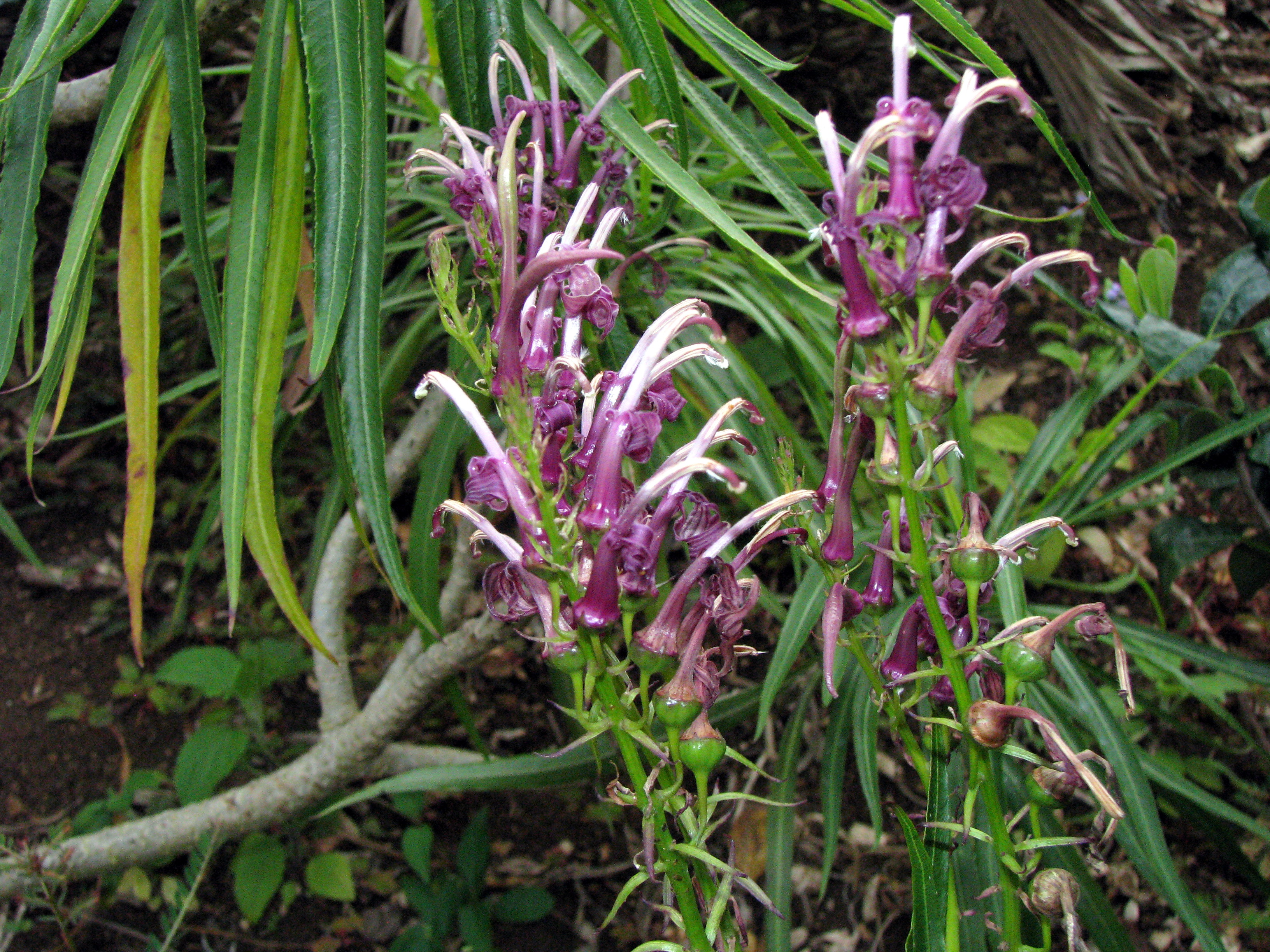
Getting to know your Hawaiian Lobeliads #16: Lobelia niihauensis

Lobelia niihauensis

  • Conservation Status: Rare
  • Distribution: Ni’ihau, Kaua’i, O’ahu (Northern Wai’anae Mts)
  • Date photographed: 8/10/2011
  • *Identification: Form– Stems woody, prostrate, 2-4 dm long. Leaves– Leaves narrowly elliptic or oblanceolate; 7-15 cm long, 0.7-1.8 cm wide; sessile or subsessile. Flower– hypanthium obconical to hemispherical, 2-5 mm long; calyx lobes linear to triangular, 1-5 mm long; corolla magenta, 22-36 mm long, 3-5 mm wide, lobe spirally revolute.
  • Phylogenetic comments: Lobelia niihauensis is thought to be closely related to Lobelia monostachya of the Southern Ko’olau Mts.
  • Links: Smithsonian Flora of the Hawaiian Islands, UH Botany, Native Hawaiian Plants- Lobelia
*From Manual of the Flowering Plants of Hawai’i
Posted in Botany | Tagged , | Leave a comment

Pupukea Redux

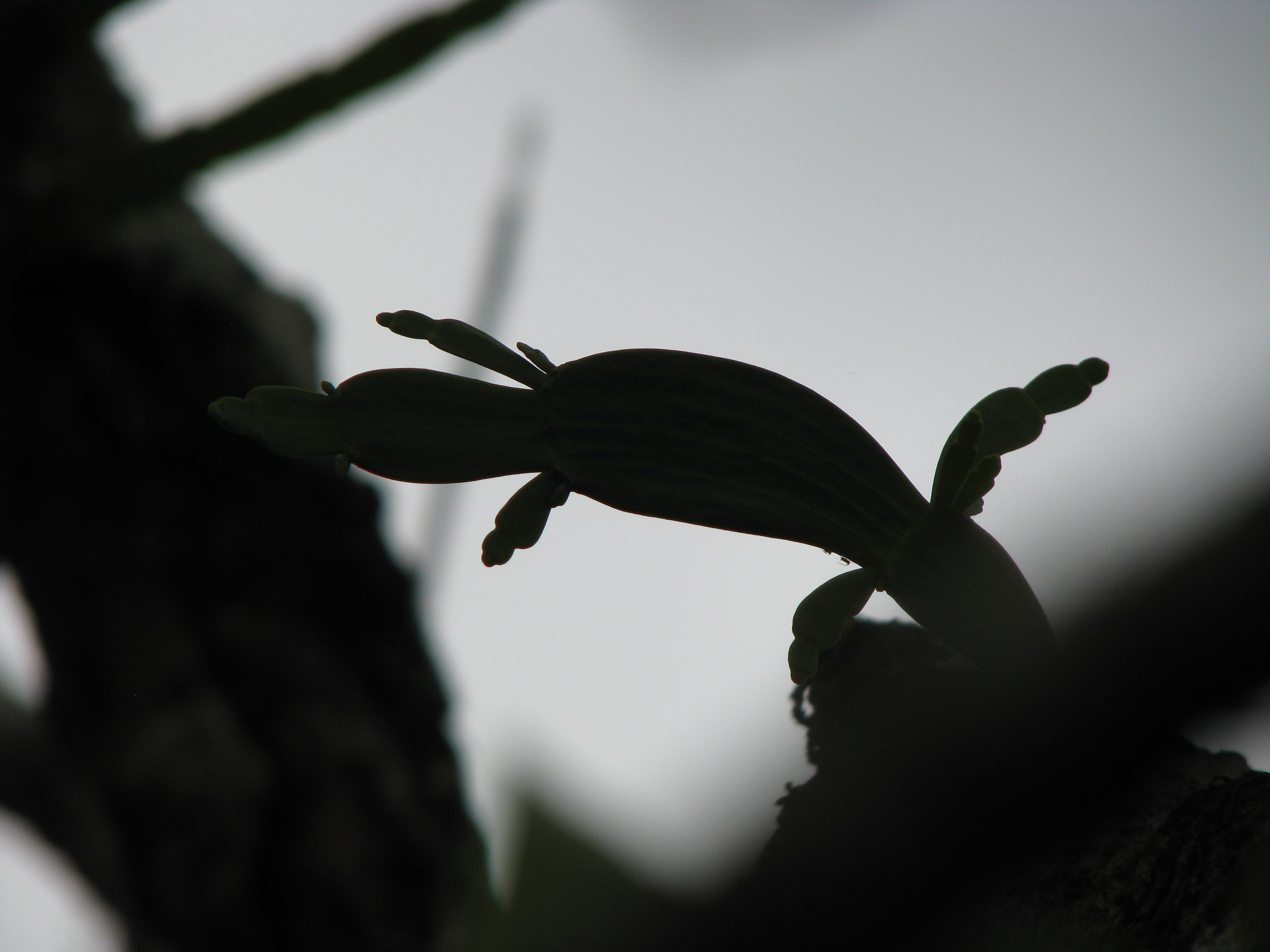
Looking like a lizard...

I had mentioned in my last article about plants that I had seen previously in Pupukea. Only after posting that did I realize that I never uploaded the other half of the Kaunala excursion. Which is a shame because there are some neat plants there that are easy to see. So, after about a 9 month interstitial, here are more plants from the Pupukea area.

Continue reading

Posted in Botany | Tagged , | Leave a comment

Snapshot: Niu Valley’s Papala

Papala (Charpentiera ovata) is still found scattered in many valleys and gulches of Moloka’i, Maui, and Hawai’i. On O’ahu its range is limited to the Southern Ko’olaus. C. ovata is split into 2 different varieties. The more common var. ovata has leaves with the widest point near the base of the leaf.

The other variety, the aptly named niuensis, is only found in Niu and Wailupe Valley. I came across this individual off a side spur of Niu. This population of C. ovata has the widest point near the middle of the leaf lengthwise, giving it a more elliptic overall appearance.

Posted in Botany | Tagged | Leave a comment

Loulu of La’ie

A few weeks back, I had the pleasure of attending Don Hodel’s talk on the native Loulu palms (Pritchardia spp.) found here in Hawai’i. It was highly informative. Mostly, Dr. Hodel focused on the key distinctions between various species. The very next week, as if on cue, the L.I.C.H. Native Plant Initiative was having their Pritchardia hike. Armed with this new found knowledge, I joined them on a hike for Loulus above La’ie.

Continue reading

Posted in Botany | Tagged , | 4 Comments

Snapshot: Gahnia vs. Gahnia

Sedges are a key component of the forest understory. Here, I just wanted to highlight the big difference between 2 native species of Gahnia is Hawai’i. The infloresence for the 2 is quite different. Pictured above is Gahnia beecheyi. It is still a common plant on many trails  on O’ahu. Pictured below is it’s congener, Gahnia aspera.

This was the plant from the Kaunala trail. Notice how much more robust the infloresence is on G. aspera. I don’t believe they are sympatric: G. aspera is typically found in drier areas than G. beecheyi. Keep an eye out for both.

Posted in Botany | Tagged , | Leave a comment