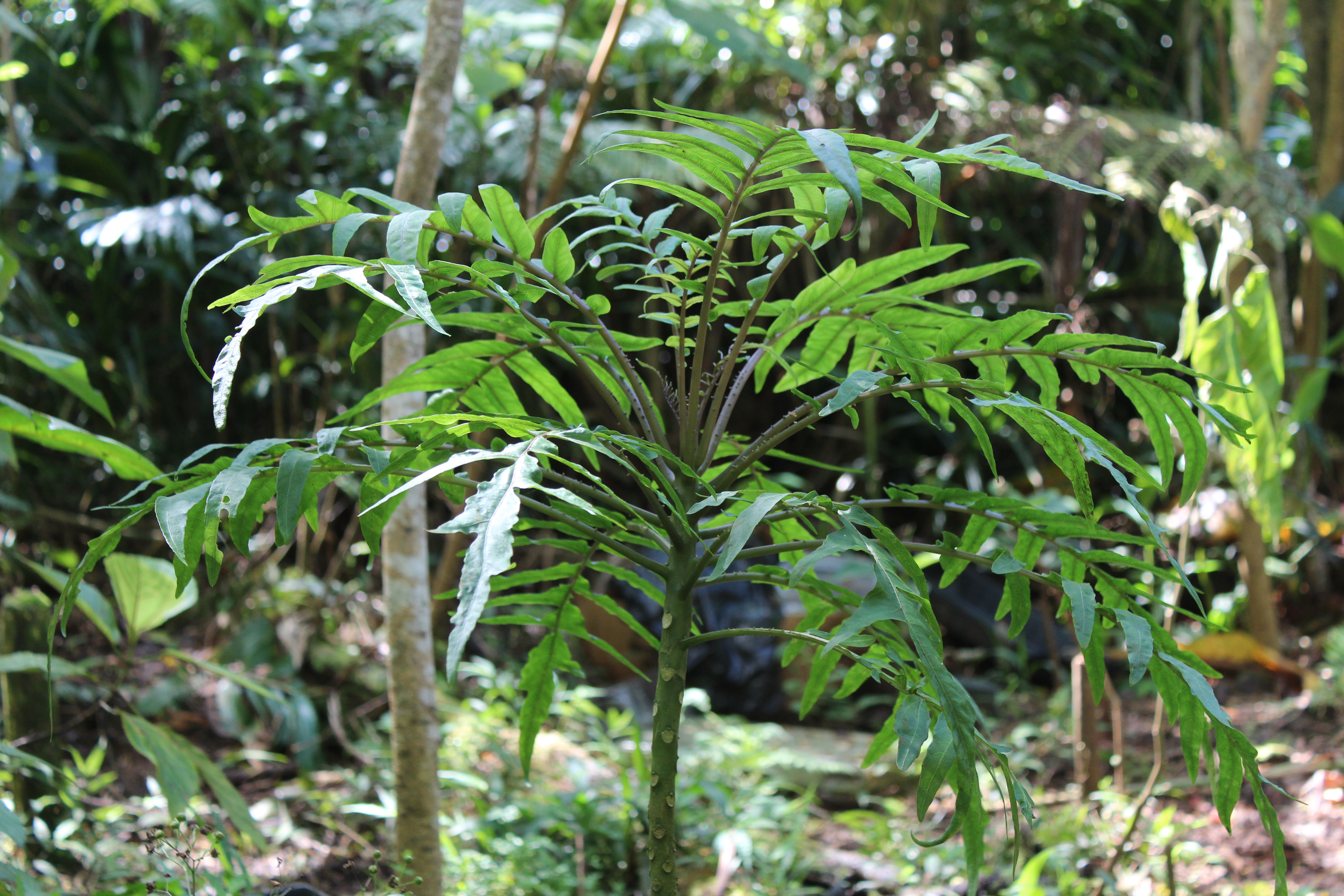
Getting to know your Hawaiian Lobeliads #31: Cyanea asarifolia

cyanea asarifolia

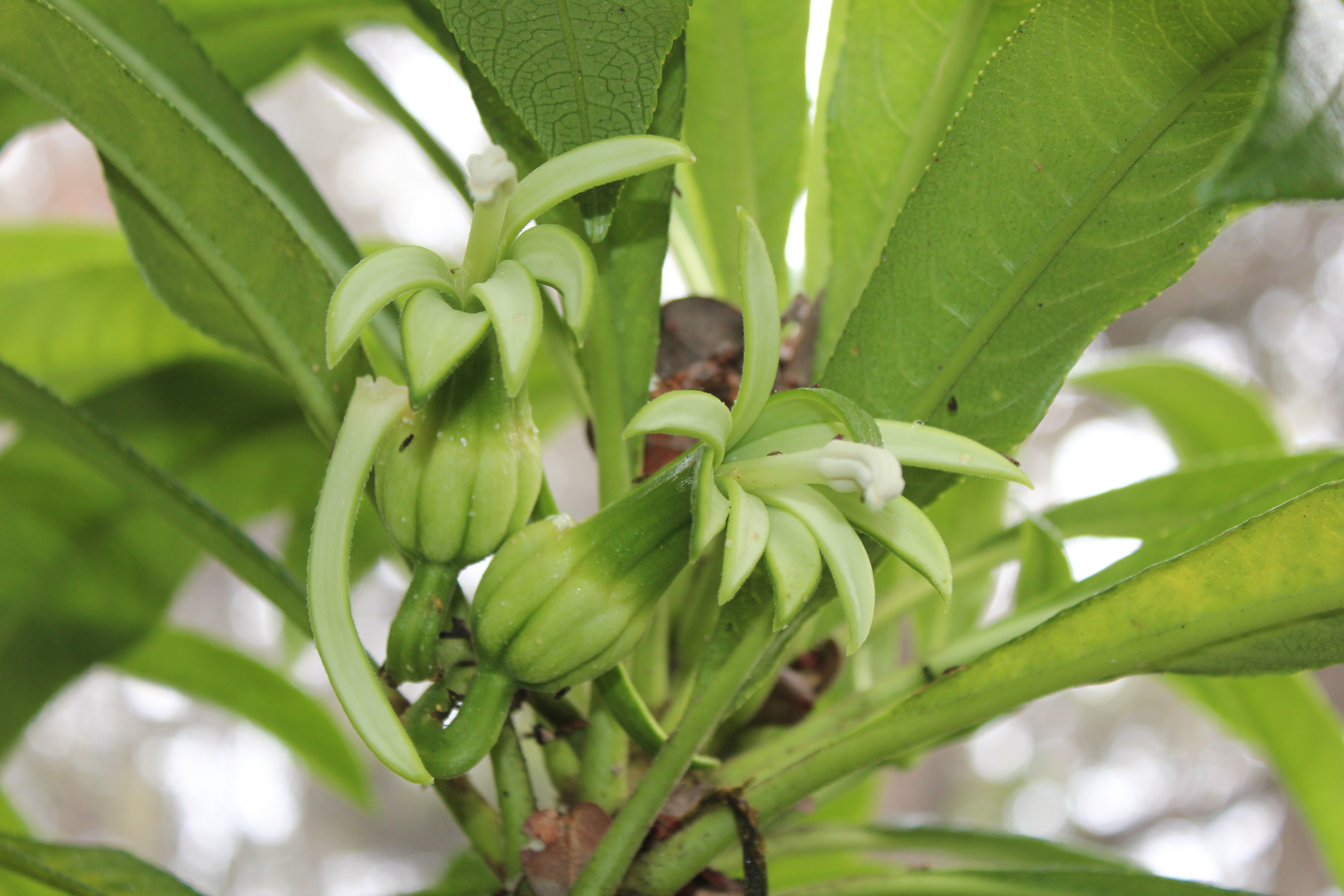
Cyanea asarifolia

  • Hawaiian Name: Haha
  • Conservation Status: Endangered
  • Distribution: Kaua’i (Anahola stream)
  • Date photographed: 8/29/2014
  • Ease of viewing: Cultivated
  • *Identification: Form– Shrub, 0.3-1 m tall Leaves– cordiform, blades 8.5-10.5 cm long, 7-8 cm wide, base cordate. Flower– calyx lobes dentiform, 0.51 mm long; corolla white with purple longitudinal stripes, 20-22 mm long, 3-3.5 mm wide.
  • My notes: There really aren’t enough photos out on the internet of this species which is a shame. This Kaua’i Cyanea is certainly one of the more distinctive looking of the genus. I can’t say I know of any that have heart shaped leaves like this guy. Awesome plant, I felt very privileged to photograph it at the greenhouse.
  • Links: Smithsonian Flora of the Hawaiian Islands, UH Botany, Native Hawaiian Plants- Cyanea
  • Additional Pics:

Cyanea asarifolia leaf

Cyanea asarifolia underside

*From Manual of the Flowering Plants of Hawai’i

Posted in Botany | Tagged , | Leave a comment

The myth. The legend. Wailupe

IMG_3156

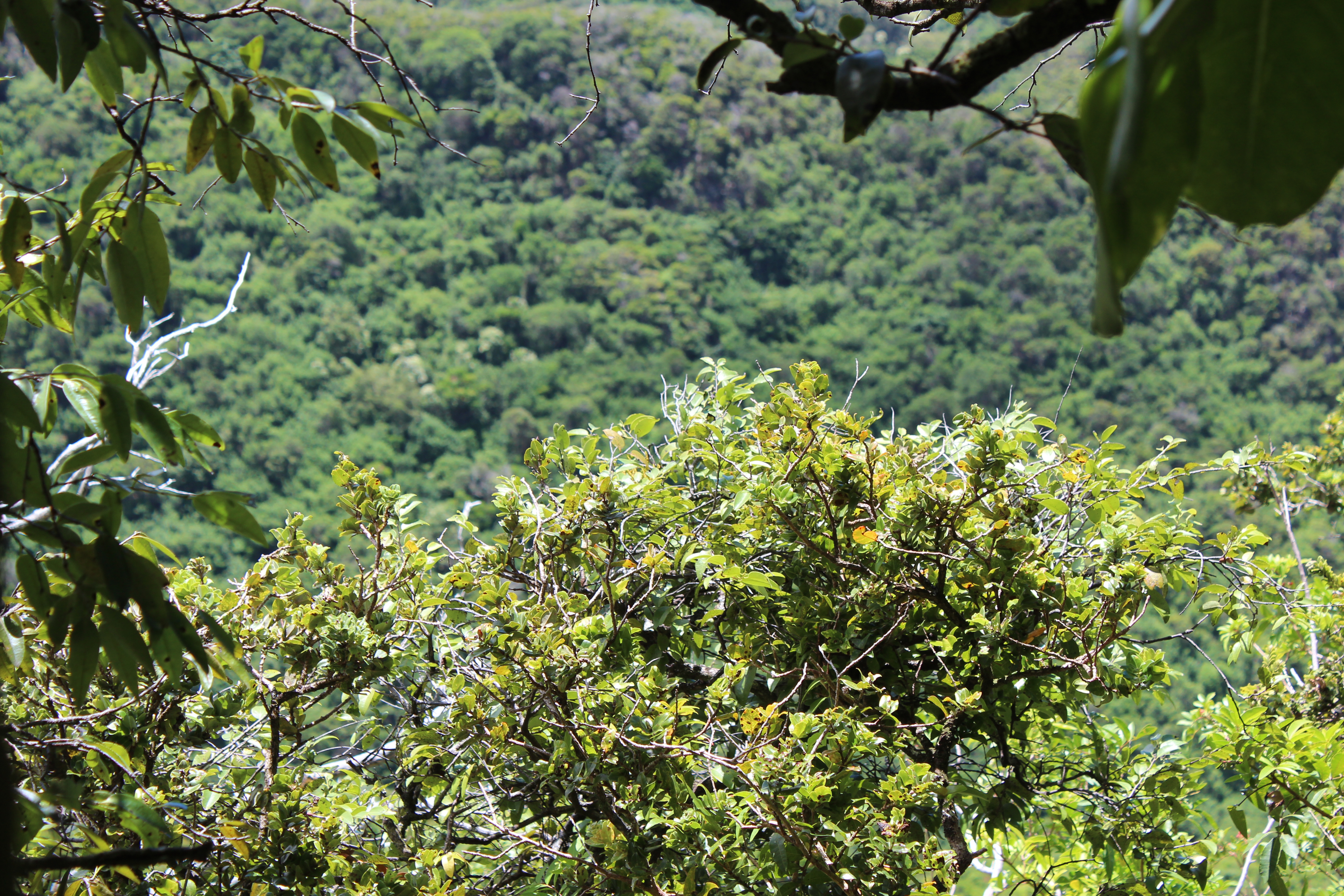
How can I properly frame this? On O’ahu, few places have intrigued me as much as Wailupe. A lot of it has to do with its historical association with the scientific inquiry of Hawaiian biota. Some of it is because of the native assemblage the valley still retains. But I think a lot of it has to do with that same ole recurring theme here at Studia Mirabilium: Sharing the Planet. Here are some awesome native forests in a valley that Hillebrand once roamed. And it’s all right behind urban Honolulu…

Continue reading

Posted in Botany | Tagged , , | 3 Comments

Kuli’ou’ou plants

'Ohi'a flowers

We went on a hike to check out the plant life of Kuli’ou’ou Valley. It was impressive to see the diversity still left in such a commonly hiked area.

Continue reading

Posted in Botany | Tagged , , , | 2 Comments

Getting to know your Hawaiian Lobeliads #30: Clermontia lindseyana

C lindseyana form

Clermontia lindseyana

  • Hawaiian Name: ‘Oha wai
  • Conservation Status: Endangered
  • Distribution: East Maui, Hawai’i (Windward Mauna Kea, Ka’u, South Kona)
  • Date photographed: 8/23/2013
  • Ease of viewing: Outplanted
  • *Identification: Form– Terrestrial shrubs or trees 2.5-6 m tall. Leaves– oblanceolate or elliptic; blades 13-24 cm long, 3.8-6.5 cm wide; margins callose-crenulate; petioles 2.5-7 cm long, pubescent. Flower– Perinath green or rarely tinged purplish outside, white or cream internally, 55-65 mm long, 9-18 mm wide, pubescent
  • Phylogenetic comments: Clermontia lindseyana is part of a polytomy of species who’s center of radiation seems to be the Big Island.
  • My notes: Working with Baron at the Hakalau greenhouse to help with this species was a real treat. Hiking out and seeing outplanted individuals growing vigorously was all the more satisfying because of it.
  • Links: Clermontia lindseyana 5year Review (pdf), Smithsonian Flora of the Hawaiian Islands, UH Botany, Native Hawaiian Plants- Clermontia; Givnish TJ, Bean GJ, Ames M, Lyon SP, Sytsma KJ (2013) Phylogeny, Floral Evolution, and Inter-Island Dispersal in Hawaiian Clermontia (Campanulaceae) Based on ISSR Variation and Plastid Spacer Sequences. PLoS ONE 8(5): e62566. doi:10.1371/journal.pone.0062566;
  • Reference: Pender, Richard “Flora trait evolution and pollination ecology in the Hawaiian lobeliad genus Clermontia (Campanulaceae)” Diss. U. of Hawaii, 2013, print
  • Additional Pics:

C lindseyana flowers

*From Manual of the Flowering Plants of Hawai’i

Posted in Botany | Tagged , | Leave a comment

Snapshot: Deep Time Conservation

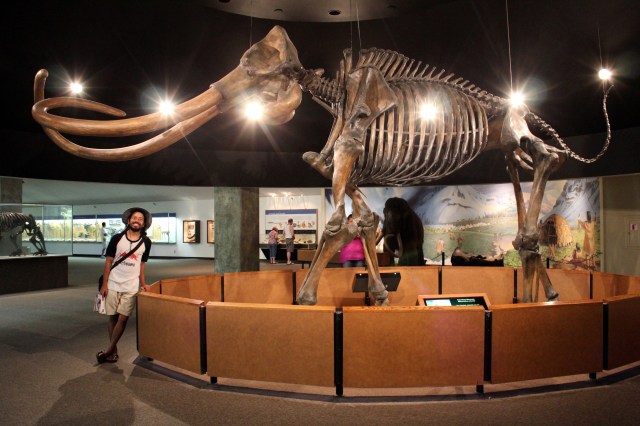
Columbian Mammoth

Whenever I’m in Los Angeles, I have to stop by the La Brea Tar Pits (well, asphalt seeps). Actually, NEED to stop by is more appropriate. As odd as this may sound to some people, La Brea is my “Happy Place”. For whatever metaphysical persuasion you are so incline, my soul is filled whenever I walk amongst those American giants. When it comes to my biogeographic sensibilities, nothing clarifies and centers it like La Brea.

But for the purposes of this post, La Brea really highlights my… intuition when it comes to Deep Time. I think for many people, they look up at these fossils and think “Wow, look at all these ancient, prehistoric fossils! I can’t even fathom the world that they lived in.” To me, these fossils, are our contemporaries. Their world is our world. It is fathomable to me.

Another, perhaps more poignant way to look at it is with recent extinction. We lament that the po’ouli (Melamprosops phaeosoma) and the baiji (Lipotes vexilifer) went extinct as recently as 2004 and 2007 respectively. We wonder if we could have done more so that they could still be around today. The fabled Tasmanian Wolf (Thylacinus cynocephalus) was alive within living memory; the last known individual died in 1936. It tugs particular hard at the heartstrings to know that it was sooo close to surviving to the present day. When I look at that Columbian Mammoth (Mammuthus columbi) at the Page Museum, I feel exactly the same way. The amazing American Megafauna, so taxonomically diverse and unique, was sooo close to making it to the present day.

I live in Hawai’i, a place were the biota has gone through unbelievable turnover in the past few hundred years. How has that awareness plus my nostalgia brought on by Deep Time not crushed my soul? Why am I not crying everyday, lamenting about the birds we lost? Because intimacy with Deep Time works both ways. If 10,000 years ago is now, then 10,000 years in the future is also now. Can we work to rehabilitate native ecosystems in 20 years? It will be awfully hard. What about restoring a native forest within a modern grant cycle of 2 years on average? Probably not. But 10,000 years? Now we’re on to something. When you’re working in conservation and you’re liberated of time constraints… it is pretty damn hopeful.

Posted in Sharing the planet | Tagged , | 1 Comment

Snapshot: Cyanea’s African Relatives

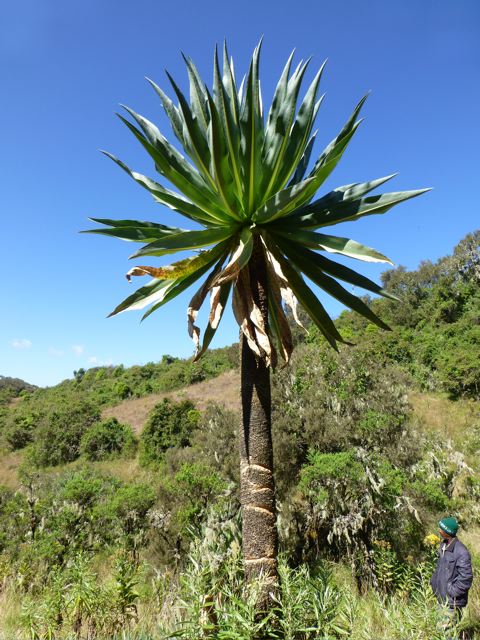
Africa. Where the Pleistocene Megafauna still lives. While it’s easy to focus on all the large animals, Africa holds a specific interest for the Hawaiian plant nerd in me. For research (Givnish, 2008) shows that some of the Hawaiian Lobeliads closest relatives may surprisingly be a clade of African montane lobeliads.

Luckily, long time Manoa Cliff supporters and occasional volunteers Jim and Cindy Waddington recently came back from a trip to the Simien Mountains in Ethiopia. They were able to find and take photos of the cousins to our Hawaiian Lobeliads.

Courtesy of Cindy Waddington

Courtesy of Cindy Waddington

Wow! These lobelias of the Ethiopian Highlands are impressive! This is probably Lobelia rhynchopetalum. It, like the Hawaiian endemic sect. Galeatella, is semelparous. If you think it is awe-inspiring vegetatively, wait till you see it in full infloresence:

Courtesy of Cindy Waddington

Courtesy of Cindy Waddington

Excuse me while I pick my jaw off the ground! Maui might have Lobelia gloria-montis, but this is pretty darn incredible. Let’s close with an awesome shot I found on wikipedia with an endangered Ethiopia Wolf (Canis simensis).

via Wikipedia Commons

Posted in Botany | Tagged , , | Leave a comment

Flowers of Ka’upulehu

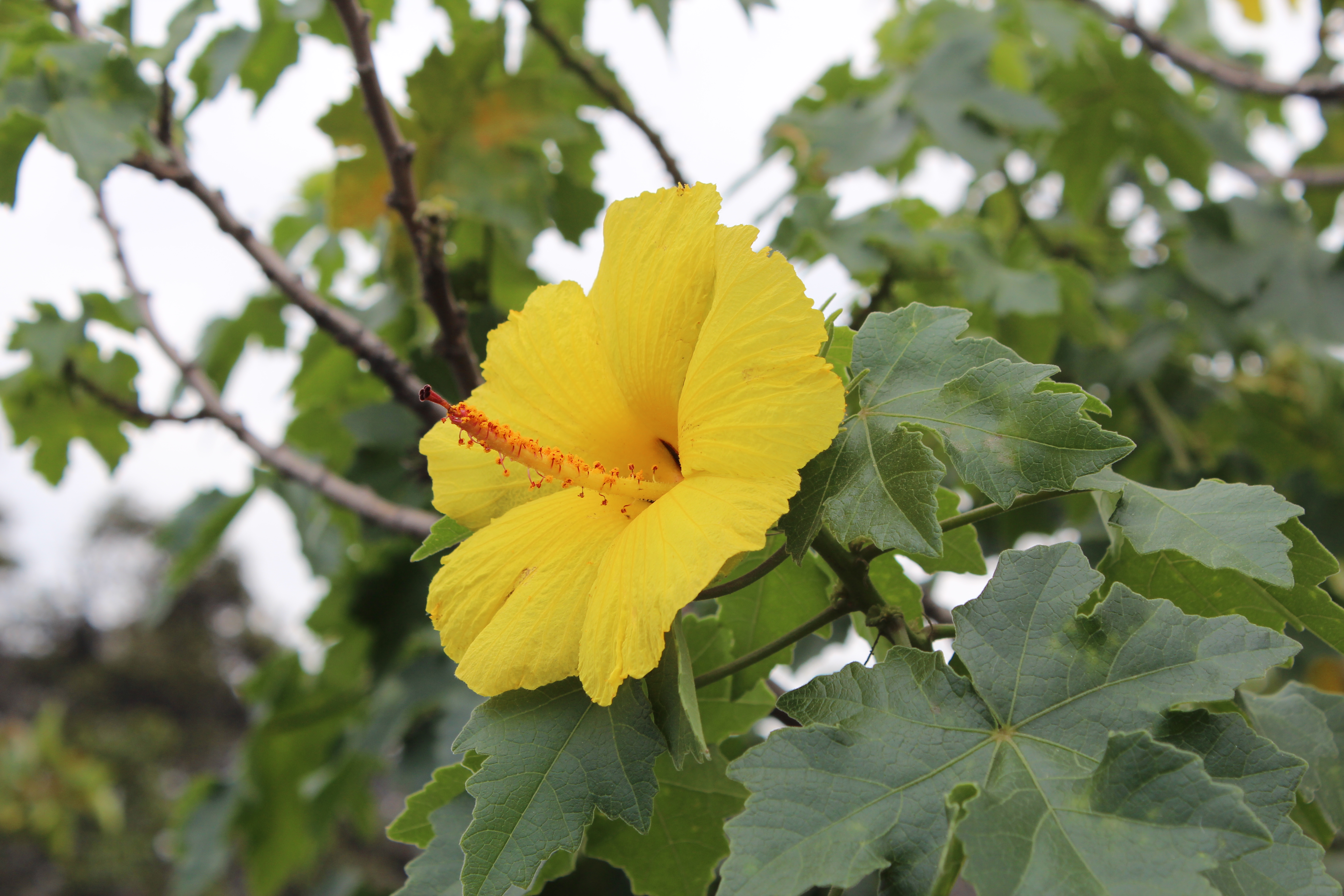
Mao Hau Hele

I was finally able to visit the Ka’upulehu dryland forest near Kailua-Kona on the Big Island. After spending some quality time in that lava-strewn forest, I cannot say enough about that place. It was some of the most amazing, hopeful forest that I have ever seen here in Hawai’i.

Continue reading

Posted in Botany | Tagged , , , , , | Leave a comment

Getting to know your Hawaiian Lobeliads #29: Cyanea grimesiana

Cyanea grimesiana

Cyanea grimesiana ssp. grimesiana

  • Hawaiian Name: Kuenui?
  • Conservation Status: Endangered
  • Distribution: O’ahu (Mt. Ka’ala, Ko’olau mountains), Moloka’i
  • Date photographed: 2/26/2014
  • Ease of viewing: outplanted
  • *Identification: Form– Sparingly branched or unbranched shrubs 1-3.2 m tall, muricate. Leaves– pinnately divided, blades 2758 cm long, 14-32 cm wide (across segments), segments 912 per side, petioles 8-32 cm long, muricate. Flower– calyx lobes ovate to lanceolate, 10-44 mm long, 4-14 mm wide, overlapping at the base; corolla greenish to yellowish-white, often suffused or striped with magenta, 55-80 mm long, 5-10 mm wide
  • Phylogenetic comments: The Cyanea grimesiana species complex has been subdivided into the following taxa: C. grimesiana ssp. grimesiana, C. cylindrocalyx, C munroi, C. magnicalyx, C. mauiensis, and C. grimesiana ssp. obatae.
  • My notes: The plight of this taxa in the Ko’olau mountains is simultaneously sad and hopeful. One last dying individual was discovered around 2004. It had very few leaves left. The prospect for fruit were slim. Tissue cultures of the lone individual were taken and plants were able to be fitfully grown in micro-propagation. In the intervening time, the original plant in the wild died. The healthiest of the propagated materials were eventually selected for outplanting. Long story short, this taxa came within a hairsbreadth of being extirpated in the Ko’olau mtns. While there is still a chance that unknown individuals are still out there, we are very lucky to still have this plant around.
  • Links: Cyanea grimesiana ssp. grimesiana 5-year review (pdf), Smithsonian Flora of the Hawaiian Islands, UH Botany, Native Hawaiian Plants- Cyanea

*From Manual of the Flowering Plants of Hawai’i

Posted in Botany | Tagged , , | Leave a comment

Snaphot: Hawaiian Avifauna

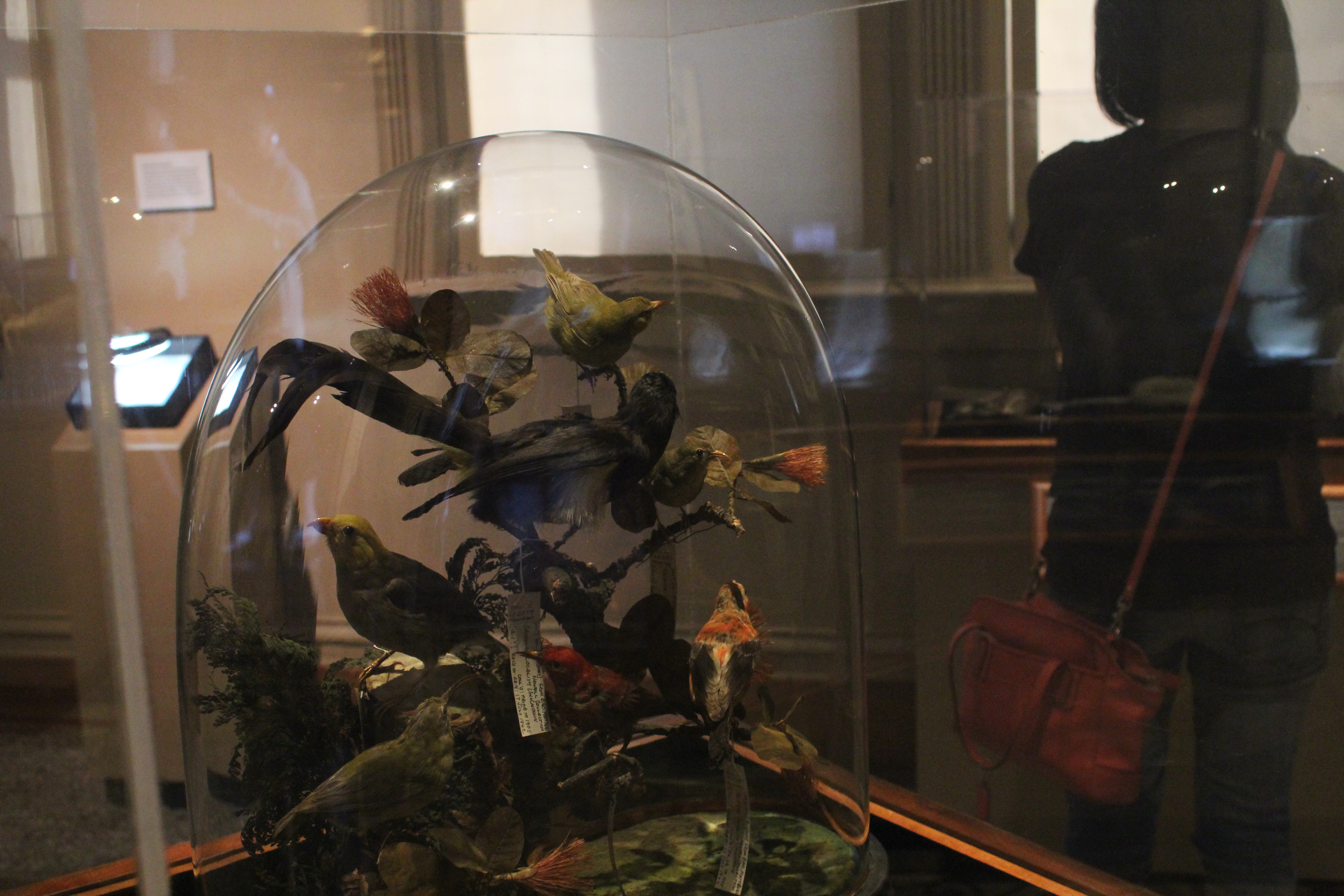
Hawaiian birds

The work by Dr. Helen James and Dr. Storrs Olson has greatly enriched our knowledge of the birds of Hawai’i. I’ve read as many of their *papers as I can. I was surprised to see this awesome mural when I visited the Smithsonian campus at Washington D.C. Aside from the speciose honeycreepers… look at all the other lineages represented in Hawai’i! Crows, Eagles, Flightless Ducks, Flightless Ibis; this great mural shows the other elements missing from today’s birdlife. Oh to have witness this firsthand…

*By the way, the 2011 paper on updating Hawaiian Honeycreeper phylogeny with respects to temporal events is a must read. Telespiza Finches nested deeper within the drepanididae radiation… yowza!

Lerner, Heather R L., Meyer, Matthias, James, Helen F, Hofreiter, Michael and Fleischer, Robert C 2011. Multilocus Resolution of Phylogeny and Timescale in the Extant Adaptive Radiation of Hawaiian HoneycreepersCurrent Biology, 21(21): 1838-1844.

Posted in Animals | Tagged | Leave a comment

Why science blogs are the best thing on the Internet

Let’s skip the actual bad stuff like deviant solicitations and other such nonsense. Even without that, the Internet can be a rather not nice place. Negativity runs rampant in so many circles of the web.

From topics as disparate as Politics to Sports to Celebrities, things can rapidly devolve into personal attacks and flame wars. It’s enough to make you question your faith in humanity.

And yet, I feel lucky to be able spend my time trolling the internet and not really see much of that. Much of my time is spend on various science blogs and searching for neat peer-reviewed papers to read. Possibly by virtue of their small niche, science blogs don’t really generate that much inflammatory commentary. Granted, some blogs do. And certainly I can always chum the waters by superficially blogging about flamebait topics. Even when you do get the random inane comment on a respectable blog, the commentariat is pretty good about policing it.

For the most part people are looking to gather more information or it’s other scientist looking to add their knowledge about the topic. But it is not this Pollyanna, circle of peace and knowledge that is the best thing to me (Although it’s nice). What I truly love is the correspondence.

I love basketball as much as the average Chicagoan that grew up in the 80’s and 90’s. While the barriers are coming down, it would be pretty hard for me to randomly ask Michael Jordan about shot selection against zone vs. man d or his thoughts about the lack of post play from today’s nba guards. I can do that on science blogs. These are some of the top minds in their respective fields. Hero worship has taken such a negative connotation nowadays, but I’d like to think I treat these blog authors with that sort of respect. It is a joy to realize these people who’s books I grew up on are so easy to communicate with now. Try not to be too much of an adoring fan, Sebastian!

If I had one wish for 2014, it would be that the best things of the sciblog community spread to more and more parts of the Internet. Keep blogging and have a Happy New Year everybody!

Posted in Random | 2 Comments