
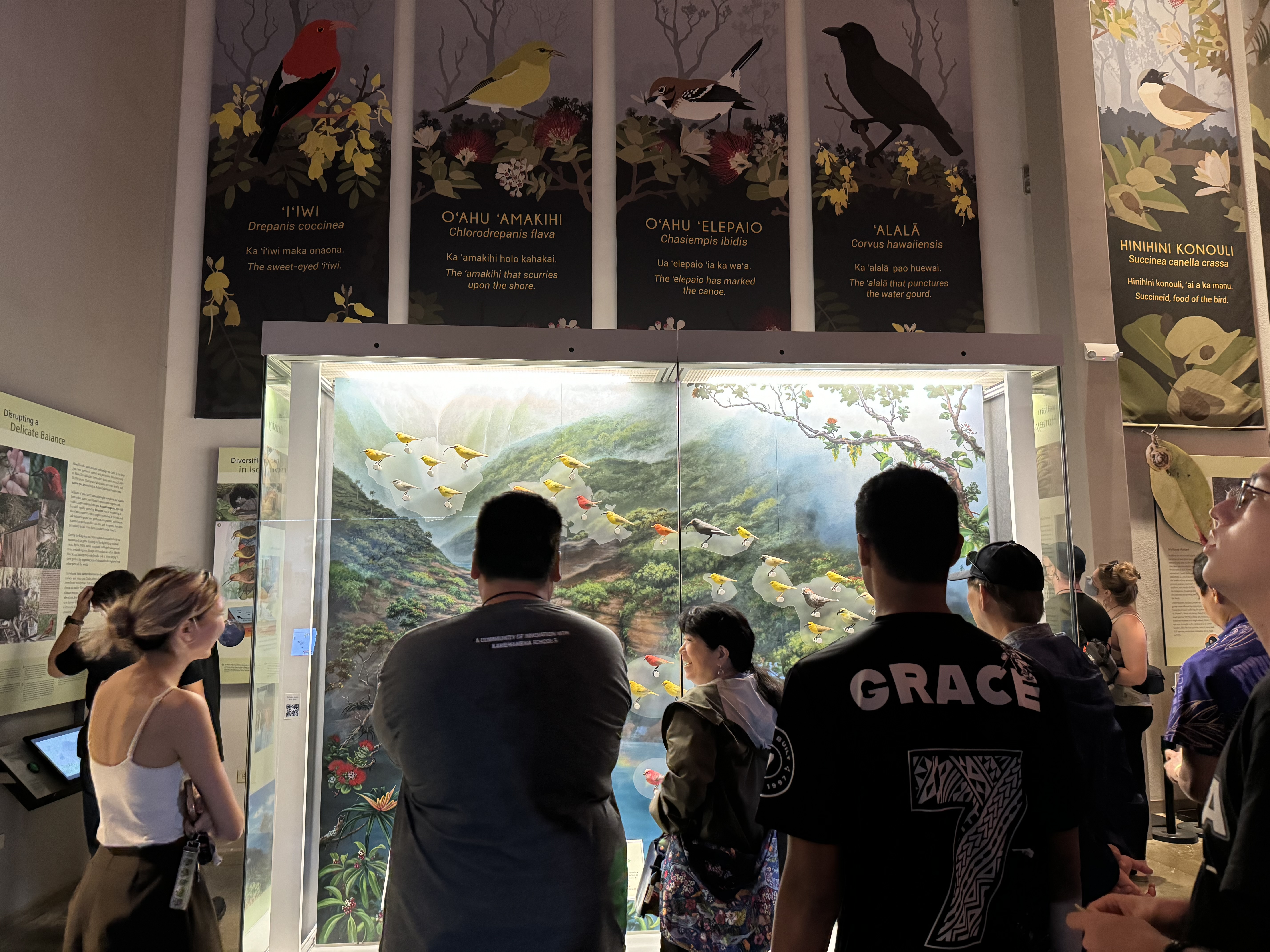
The last time I talked about Bishop Museum on this blog was that in-between phase where I wasn’t really posting often. At the time, they had put on display a rare specimen of kioea and I had commented on how it allow folks to emotionally engage with a long extinct member of the Hawaiian avifauna. Well last year, during the year of the forest bird, Bishop Museum once again did a showcase on native Hawaiian birds and it did not disappoint.
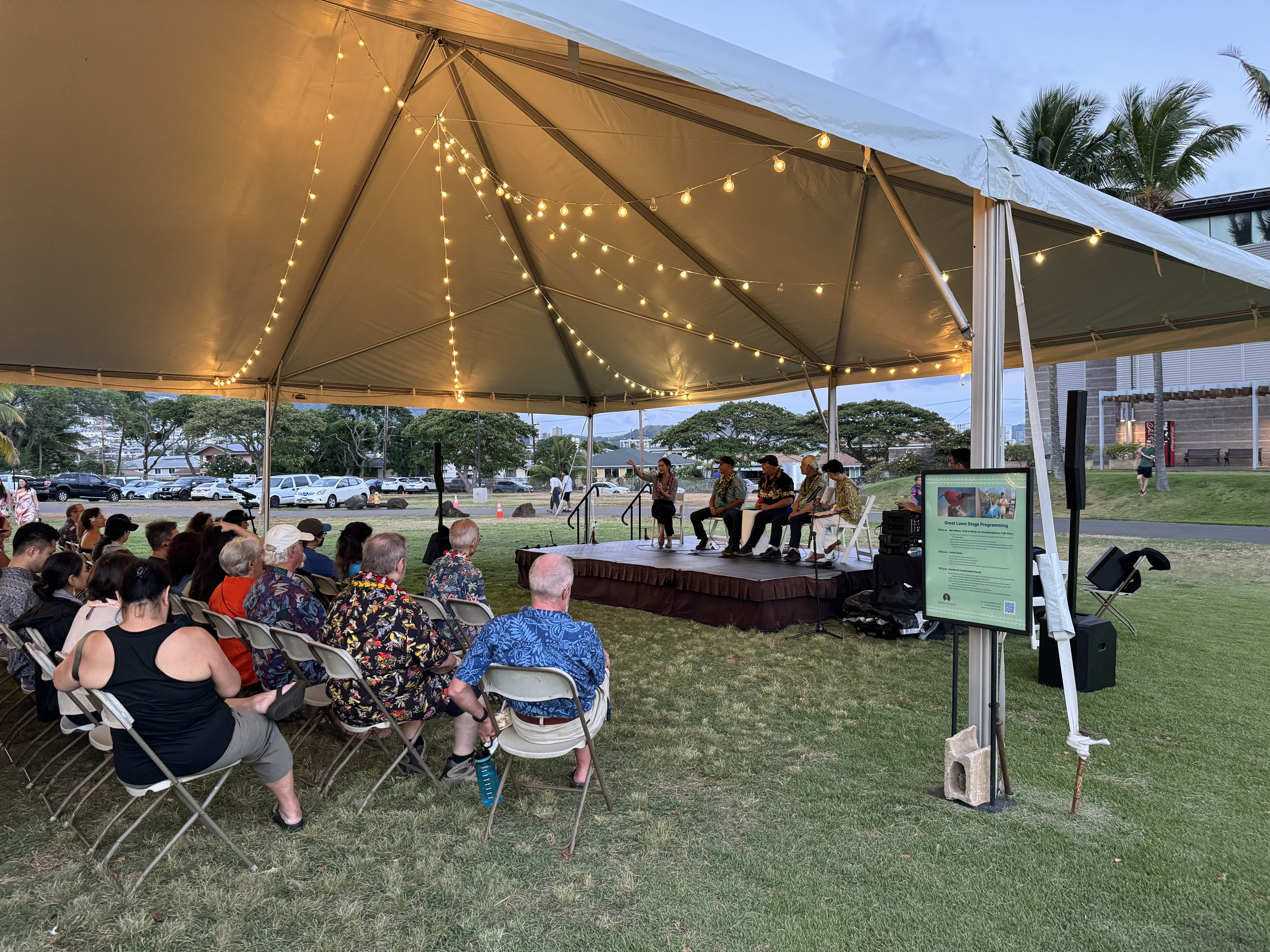
Last July, Bishop Museum had their Lele o Nā Manu festival. It was a great event, with speakers, artists, and wonderful new exhibits. There were talks and sessions with researchers and conservationists in the field. Local artist Patrick Ching made significant contributions to the exhibit space. Master carver Haruo Uchiyama flew in from Japan and renown artist Julian Hume attended from England. It was great to see support from folks all over the world.
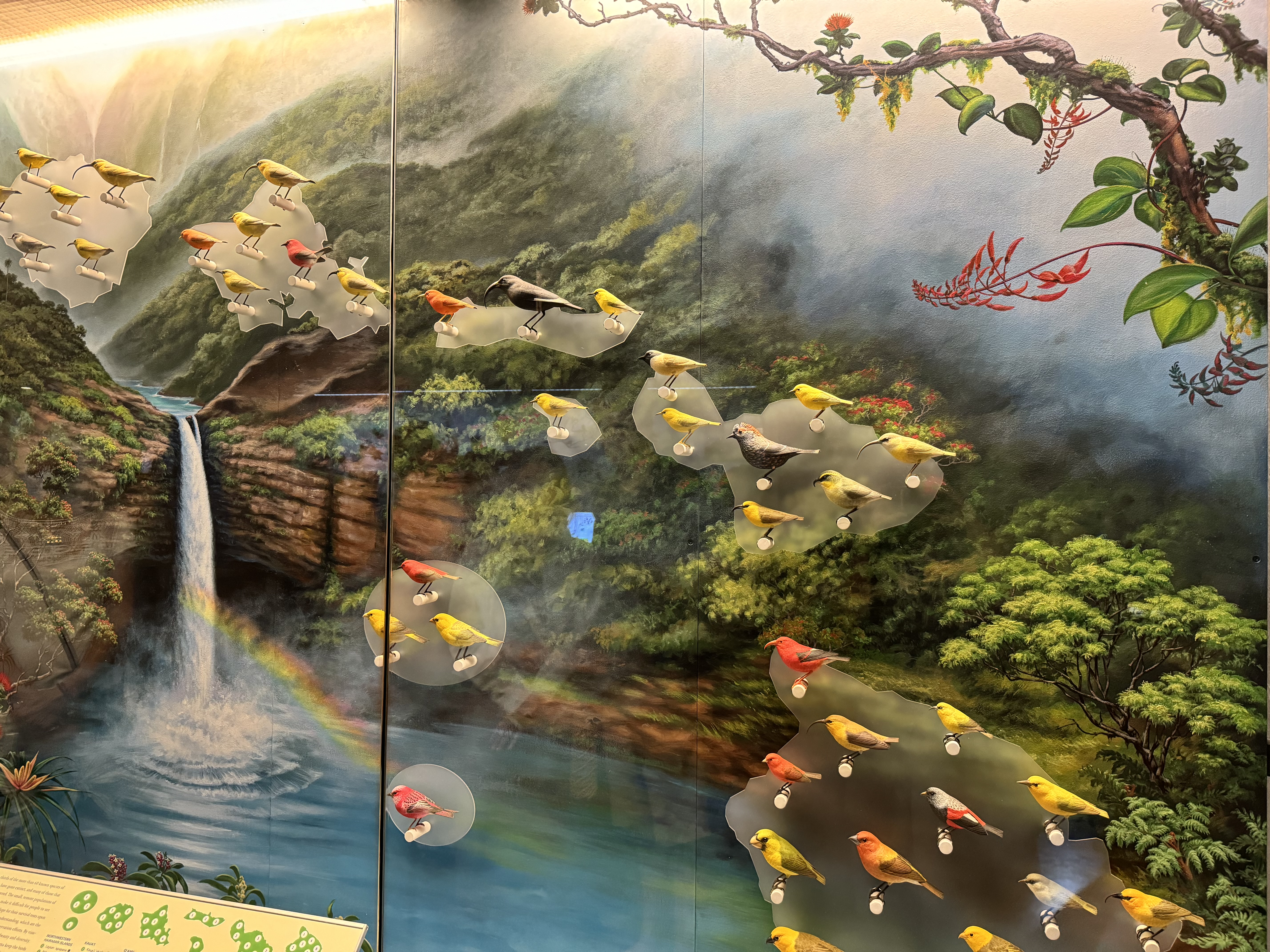
Having these exquisite carvings from Uchiyama-san really helps me visualize the native forest birds. And can really help you appreciate the evolutionary history of our Hawaiian Honeycreepers. As you can see from the diorama above, the honeycreeper radiation was extensive and diverse. Each island in the archipelago hosted their own populations with some forms autochthonous to an individual island.
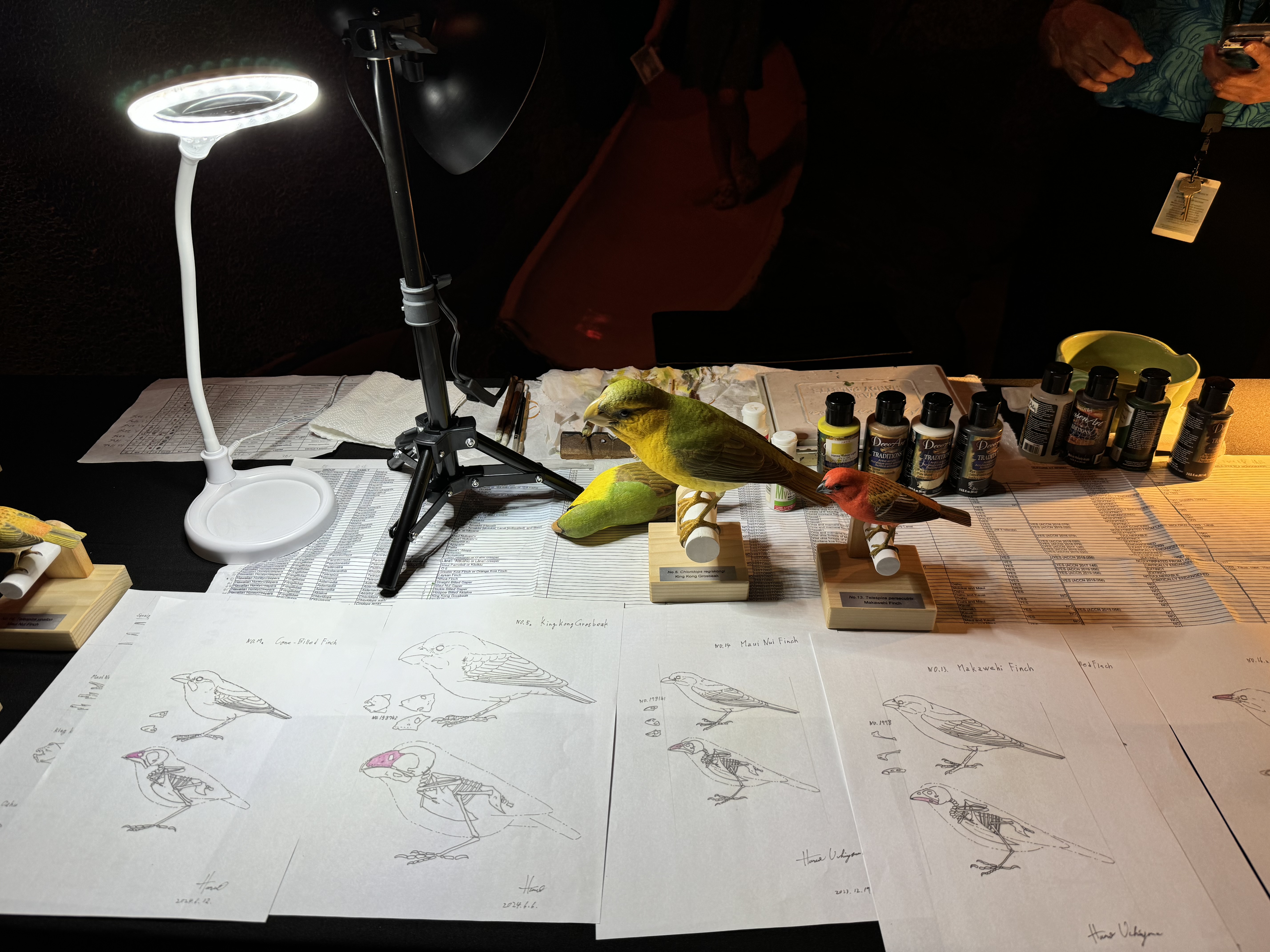

For the opening event itself, Uchiyama-san blessed us with a glimpse of his worktable allowing us a view of his methodology on carving. It was much rigorous study and research even before he picked up a chisel. We could see just how much care went into each carving.

And other native forest birds were highlighted as well. Even though they are all extinct now one cannot talk about forest birds of Hawai`i without mentioning mohoidae. There was a neat panel showcasing this small, but important radiation of nectivorous birds. One of my very early posts here at Studia Mirabilium highlighted just how interesting and strange I found their evolutionary history. They might not have been as vigorously radiating like the honeycreepers but the Hawaiian honeyeaters were no less important to the health and vigor of our forest. In fact, they were probably extremely important as lore and observations seems to show that the `o`o birds and kioea tending to dominate all other nectivorous bird species as feeding sites. In my mind, they were probably driving a lot of the selective pressures on native forest plants. If one wonders why many of our flowers look they way they do, it’s because of these guys.
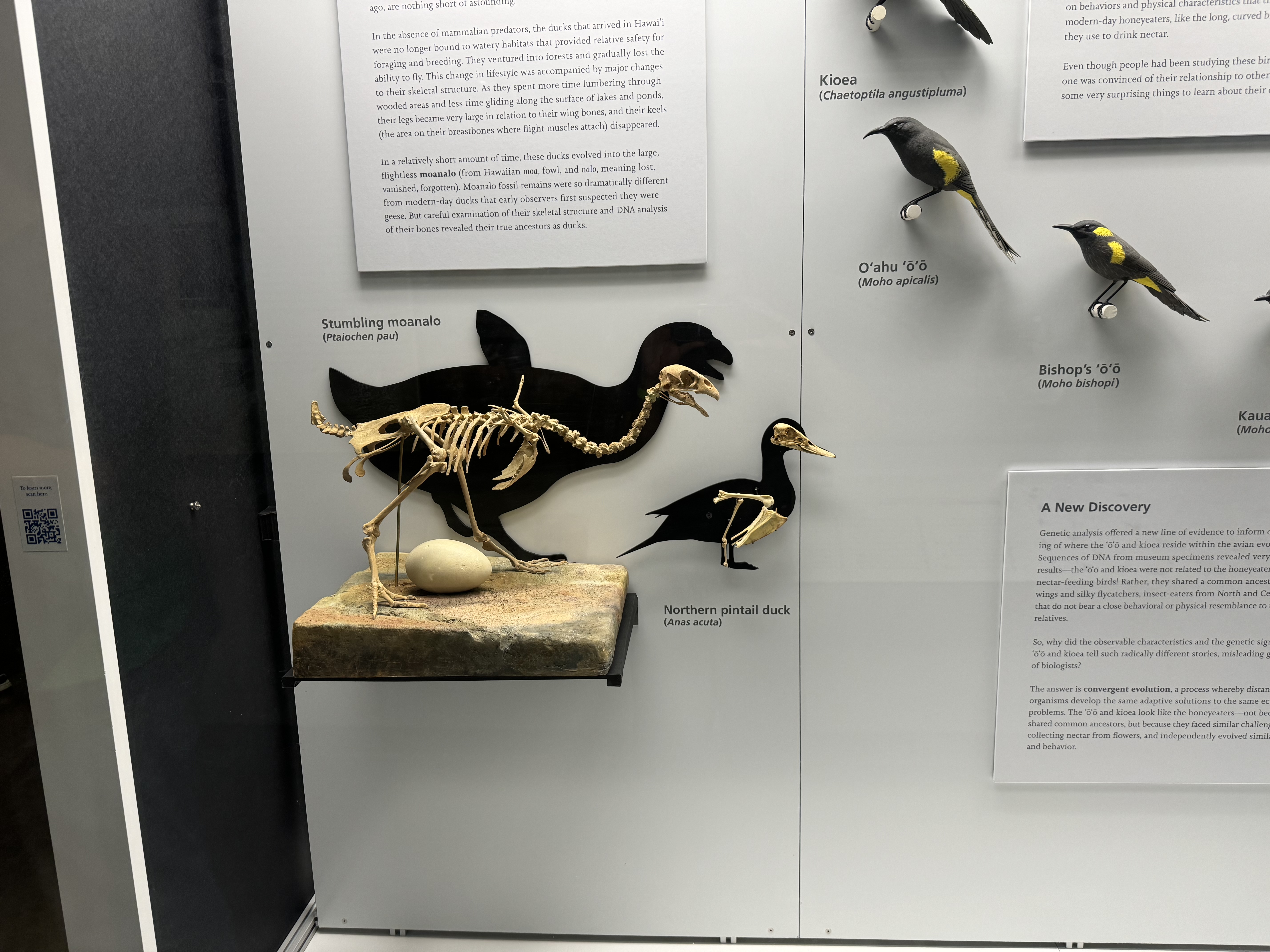
In some was the radiation of both the honeycreepers and honeyeaters makes some sense. Birds fill nectivorous and insectivorous niches in forests worldwide and it’s neat to see how birds here evolved to fill those roles. But the bird in the lower left of the panel really highlights just how unique Hawaiian forests were in the past. Large, terrestrial herbivore is a niche that isn’t really available to birds. In many ecosystems elsewhere, the largest land herbivore is usually some sort of mammal. But in habitats were mammals are absent, i.e. islands, oftentimes birds readily fill those niches. Giant Moa in New Zealand, Elephant birds on Madagascar, etc. Here in Hawai`i, waterfowl filled that void. And on the islands of Maui Nui, O`ahu, and Kaua`i, it wasn’t a goose but a type of dabbling duck that became the dominant herbivore. The elephants, if you will, of our forests.
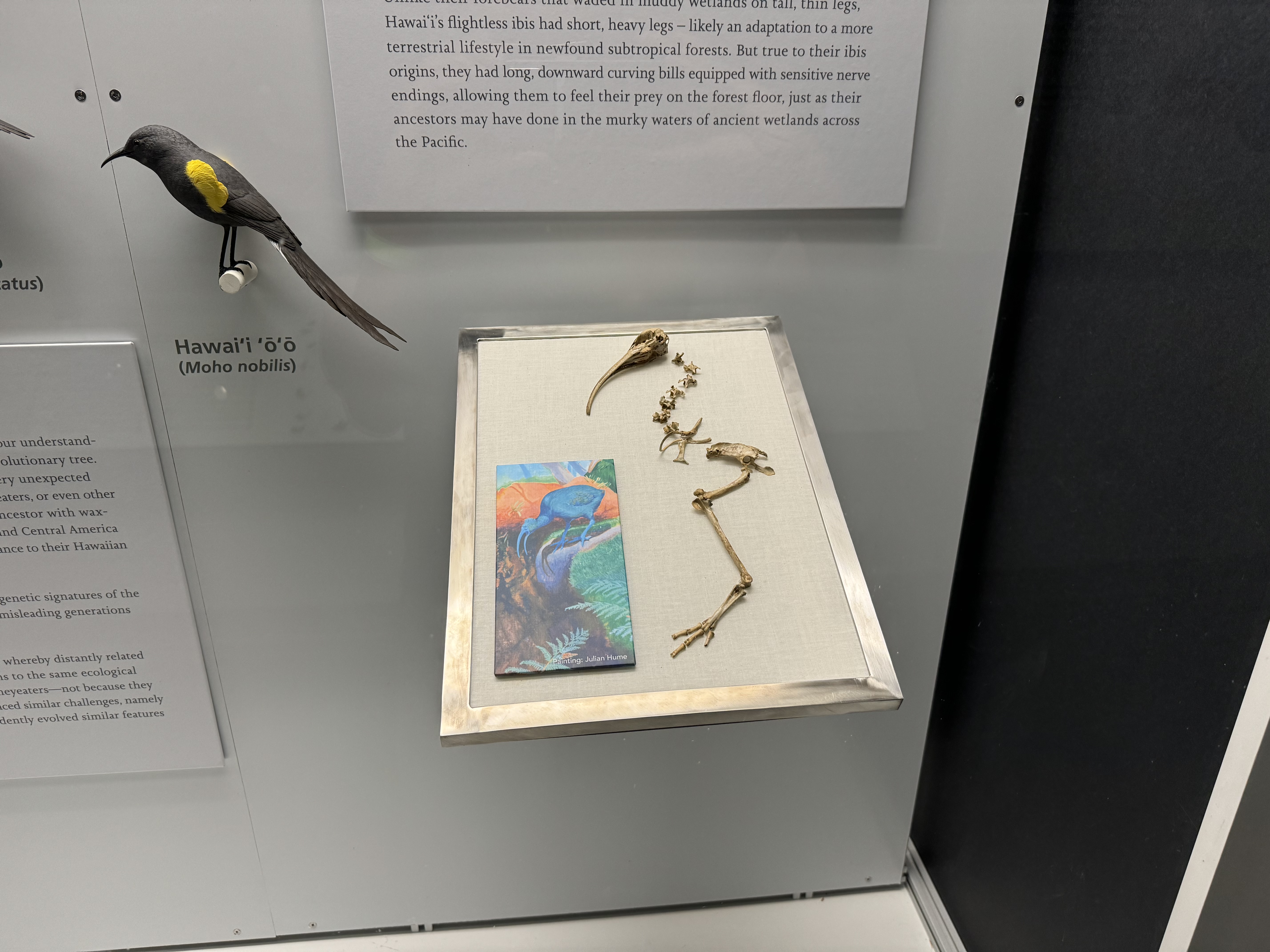
To zoom in even closer, on the islands that were formerly part of Maui Nui (Maui, Moloka`i, Lana`i, and Kaho`olawe) a unique radiation of flightless ibis evolved. Perhaps if more fossils are found in the future we’ll find out the true extent of their range here in the archipelago but for now the radiation seems to restricted to those islands. It showcases to me that not only was the avifauna here distinct compared to the rest of the world, but each island was unique even compared to each other.
So while I am sad that I don’t get to watch some large flightless duck waddle around my front lawn or watch a kioea at a nectar feeder, I am super appreciative that the Bishop Museum gave us this opportunity to have a glimpse into the Hawaiian Forest as it once was. To see that amazing diversity both on a worldwide scale as well as local in such an entertaining and educational exhibit was a highlight for me last year. It is worth the trip down to the science building to check out. It is also what gives me energy, it’s why I fight so hard to make sure the current extant forest birds don’t join this display. Until next time, I’ll be in the forest if you need me…

 Studia Mirabilium