
One of the many plants that I was happy to engage with from my trip to Limahuli last year was this guy: Hau kuahiwi (Hibiscadelphus distans). And I figure now would be a good a time as any to talk about this interesting radiation of native Hawaiian malvaceae. Hau kuahiwi as a whole have suffered greatly from anthropogenic changes but have much potential for restoration to its former glory.
Malvaceae in the genus Hibiscus have independently colonized Hawai`i several times. One each for Hau (Hibiscus tiliaceus), Akiohala (Hibiscus furecellatus), and Ma`o hau hele (Hibiscus brakenridgei). One other colonization event led to the red and white native Hibiscus (Hibiscus arnottianus, H. waimeae, H. clayi, H. kokio)
One radiation that was obscure was that of the genus Hibiscadelphus. Many of the old botanist knew of its close affinities to Hibiscus. Some old specimens were actually labeled as a Hibiscus species. The genus itself translates to “brother of Hibiscus”. Kanaka maoli also recognized the close relation as the name Hau kuahiwi translates to “Hibiscus tiliaceus of the uplands”.
Recent studies (Champion, 2020) have shown that Hibiscadelphus are part of Hibiscus sect Calyphylii. It’s interesting because all other members of that clade are of Southern/Eastern African and Madagascar origin, seemingly far from the expected colonizing areas of the Pacific Rim. The split from the rest of the African Hibiscus may possibly predate the formation of the main Hawaiian islands (~5-10 mya).

Within the genus, the study found that the two cliff-dwelling shrub species of Kaua`i (Hibiscadelphus distans, H. woodii) are sister to the rest of the larger flowered, tree species of the younger islands. The H. distans I saw at the gardens was fairly tall, but sparingly branched. Nevertheless, I thought it was a very cool plant especially its interesting flowers.
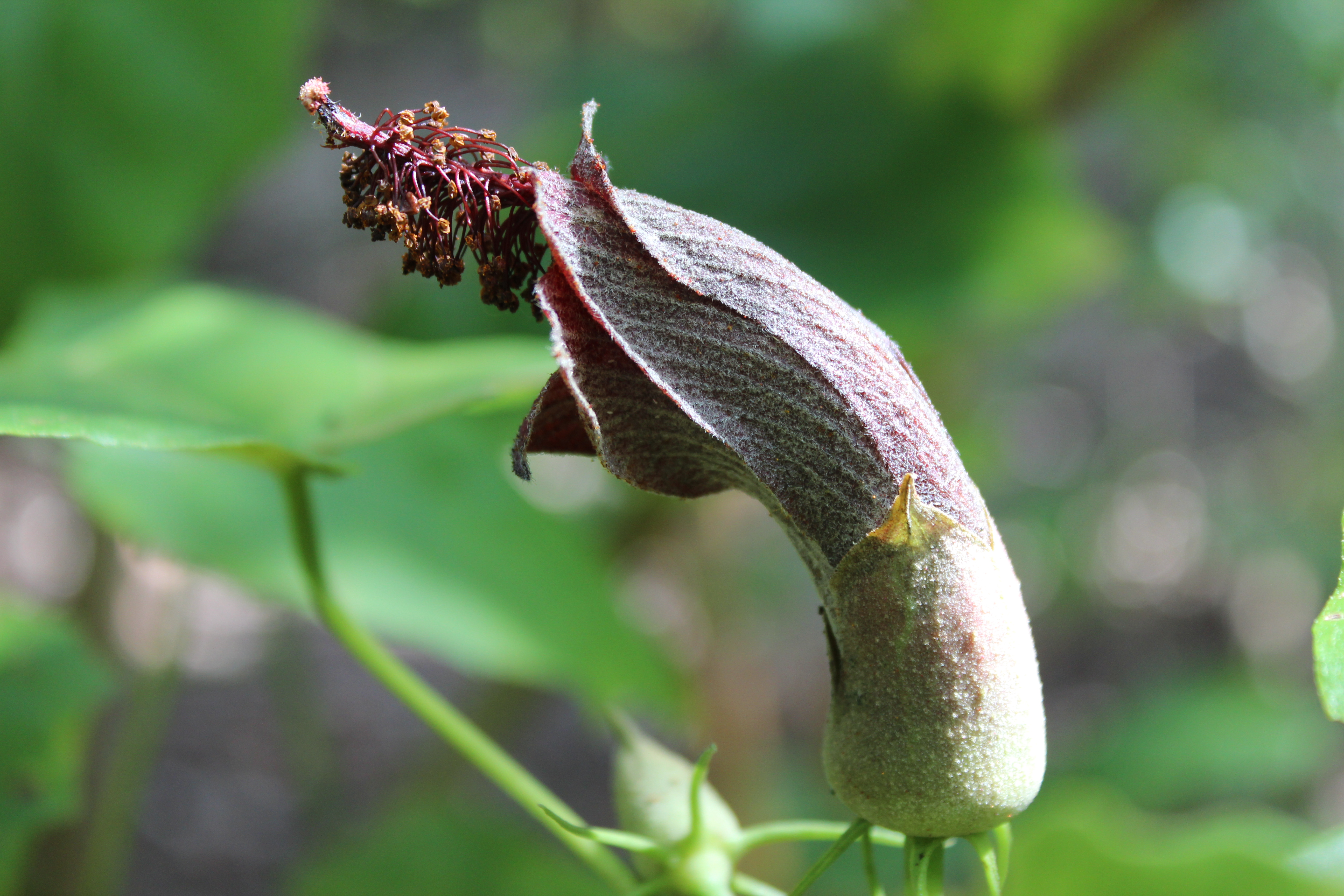
The floral morphology of all Hibiscadelphus are interesting in that they never fully open, forming a tube that seems to be specialized for bird pollination. It has been noted the flowers also produces copious amounts of nectar, further strengthening that relationship. Unfortunately many of their avian pollinators have gone extinct or have been extirpated from their remaining habitat.
Hibiscadelphus seemed to have radiated in drier habitat, which has seen some of the most environmental upheaval in the archipelago. 3 species (H. bombycinus, H. crucibracteatus, H. wilderianus) are extinct and the rest of the living species are all highly endangered. Indeed, H. woodii was thought to have gone extinct in 2011 until several individuals were discovered in 2019.
With all this destruction, it’s been surprising that there have been fairly recent discoveries. The Kaua`i species were discovered and described fairly recently: H. distans in 1972 and H. woodii in 1991. The most surprising to me was the discovery of H. stellatus on West Maui in 2012 (Oppenheimer et al., 2014). They discovered a total of 99 plants, automatically making this the largest, most robust population of Hibiscadelphus. Seedlings were also discovered, giving more hope for the long term stability of that species. Conservation work is on going with all the species, with the hope of getting more plants back onto the landscape.
So there you have it, a strange group of African Hibiscus evolved for native bird pollination greatly affected by human disturbance yet enchanting us with new discoveries. All in all a fascinating member of the Hawaiian flora.
–refs
Champion, Solomon J. Biogeography and Phylogenetics of the Hawaiian Endemic Hibiscadelphus, Hau Kuahiwi (Malvaceae). MS thesis. University of Hawai’i at Manoa, 2020.
Oppenheimer, Hank L., Keahi M. Bustamente, and Steven P. Perlman. “A new species of Hibiscadelphus Rock (Malvaceae, Hibisceae) from Maui, Hawaiian Islands.” PhytoKeys 39 (2014): 65.

 Studia Mirabilium